

Table of Contents
HANOI, 23 November 2026 (NNW Bureau) — Vietnam is advancing a large-scale electricity storage project that uses two reservoirs at different elevations to function as a giant water battery. The 1,200-megawatt Bac Ai pumped-storage hydropower facility, planned in Khanh Hoa Province, is designed to help stabilise the national power grid as electricity demand rises and renewable generation expands.
How a mountain can store electricity
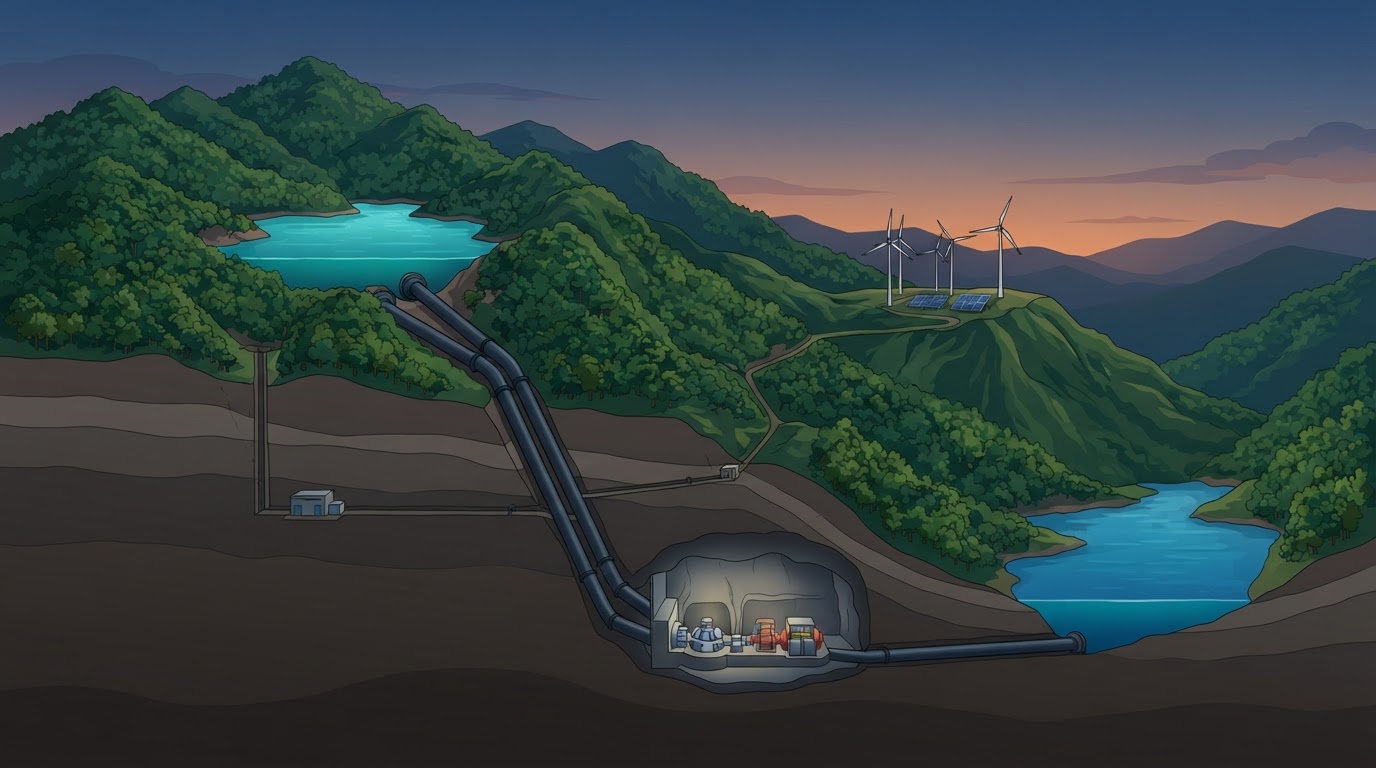
Unlike conventional hydropower, pumped-storage plants use electricity during lower-demand periods to move water uphill into a reservoir. When demand increases, water is released through turbines to generate power. The system does not create energy from nothing: it stores electricity by converting it into the potential energy of elevated water, with some energy lost in the process.
The Bac Ai plant is designed with four 300 MW generating units. Vietnam Electricity (EVN) lists estimated investment at approximately VND 21.101 trillion, equivalent to roughly US$800 million depending on the exchange rate, and identifies the project as a major component of the national Power Development Plan VIII.
Financing and equipment work continue
EVN announced that lenders and project representatives conducted a working programme from 9 to 13 November to resolve issues affecting loan disbursement. The discussions included environmental and social reviews, legal conditions, technical due diligence and requirements before the initial drawdown of funds.
An electromechanical equipment supply contract had been signed in October. Those steps mark progress, but do not mean the project is complete or generating electricity.
Long-term benefits and challenges
EVN’s current schedule targets the first generating unit for December 2029, with the remaining units to follow in 2030. Once commissioned, the plant could help manage daily fluctuations in demand and complement intermittent solar and wind generation. Its usefulness will depend on reliable operation, grid connections, financing and careful environmental management.
For other fast-growing economies in Asia, the project offers an example of using familiar water and turbine technologies to provide large-scale electricity storage without relying solely on chemical batteries.
Visual: Original NNW conceptual engineering illustration of pumped-storage hydropower, not a photograph of Bac Ai.
